Finance and fintech
Flat-rate or interchange-plus: how to choose a payment processor
Your processor touches every sale, so a small difference in fees compounds fast. Here is how to compare options on what you will actually pay.
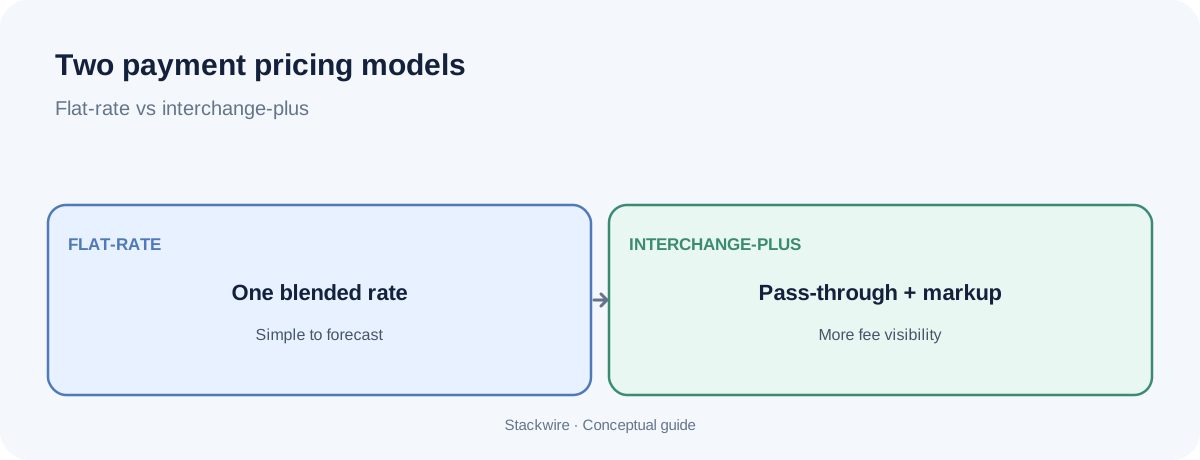
For a small or low-volume business, flat-rate pricing is usually simpler. As card volume grows, interchange-plus can cost less because you pay the underlying card fees plus a stated processor markup. Compare your own transaction mix, monthly volume and extra fees before switching.
The two main pricing models
Flat-rate bundles everything into one price, commonly around 2.9% plus 30 cents for online cards. It is simple and quick to set up. Interchange-plus passes the card network’s fee through at cost and adds a fixed processor markup, so you can see exactly what you pay for. One 2026 guide puts competitive small-business markups at roughly 0.15% to 0.30% plus a few cents per transaction.
When each one wins
Flat-rate can be easier to forecast, especially for a new or lower-volume business. Interchange-plus may become more attractive as volume grows or when your card mix includes lower-cost transactions, but there is no reliable universal monthly-volume threshold. The break-even point depends on your average ticket, card mix, channel, provider markup and additional fees. Calculate both models using your own recent transaction data.
A worked example (illustrative numbers)
Take $50,000 a month across 1,000 sales. At 2.9% plus $0.30, you pay $1,450 plus $300, or $1,750 (3.5%). On interchange-plus, assume an average interchange of 1.8% ($900), a 0.30% markup ($150) and $0.10 per sale ($100). That totals $1,150 (2.3%), a saving of about $600 a month. Your real interchange will depend on your card mix.
A checklist beyond the headline rate
- Payout speed: standard payouts often take 1 to 2 business days, and instant payouts usually cost extra.
- Account holds: ask how the processor handles reserves and fund freezes, a documented risk at higher volumes.
- Chargeback fees and how disputes are handled.
- Contract terms: monthly minimums, long contracts and cancellation fees.
- Fit: marketplaces need split payouts, and SaaS needs solid subscription billing.
What is included in a payment processing fee?
A card payment is not a single fee paid to one company. Depending on the country, payment method and contract, the merchant's total cost can include interchange, card-network assessments, the acquirer's or processor's markup, gateway or platform charges, currency conversion, fraud tools and optional services.
Visa explains that interchange is a transfer fee between the cardholder's bank and the acquiring bank. Merchants generally pay a merchant discount to their financial institution; that merchant discount can include interchange and other processing services. This distinction matters because a merchant does not simply pay Visa's published interchange rate as its entire processing bill.
Flat-rate vs interchange-plus: compare the real bill
Flat-rate pricing combines components into a simpler rate. It is easier to forecast, but the provider's blended rate may be higher than the underlying cost for some card types. Interchange-plus separates the interchange component from the processor's markup. It can improve transparency, but monthly statements may be harder to interpret and the final rate changes with the card mix and transaction qualification.
| Question | Flat-rate | Interchange-plus |
|---|---|---|
| Can you forecast the fee quickly? | Usually easier | Needs transaction mix assumptions |
| Can you see the processor markup? | Usually bundled | Usually itemized |
| Does the cost vary by card type? | Often blended into one rate | Yes, interchange varies |
| Best comparison input | Effective rate plus extras | Interchange mix plus markup and extras |
How to calculate your effective processing rate
Use the same statement period for every provider. Add processing fees and other mandatory payment charges, then divide by the total card volume for that period. Multiply by 100 to get a percentage.
(Total processing fees ÷ total processed card volume) × 100 = effective processing rate.
For example, if a business processes $40,000 in card payments and pays $1,160 in total processing fees, its effective rate is 2.9%. This number is more useful than comparing only the headline percentage because it reflects the business's actual transactions and the fees on its statement.
Run a fair provider comparison
- Collect at least one representative month of statements, ideally several months if seasonal changes are significant.
- Separate card-present, online, keyed, international and recurring transactions.
- Record average ticket size, number of transactions, refunds and chargebacks.
- Ask each provider to quote the same mix and list every recurring, per-transaction and optional fee.
- Model the total cost at current volume and at a realistic growth scenario.
- Check contract terms, payout timing, reserve policy and support before making the decision.
Estimate your monthly processing fees
Compare two hypothetical quotes using the same card volume and transaction count. Enter rates from actual provider proposals. This estimate excludes taxes and fees you do not enter; interchange is an assumed average, not a fixed rate.
Illustrative estimate: flat-rate $1,750.00; interchange-plus $1,150.00 including entered monthly fees.
Actual statements may include additional items and different card qualification categories. Use the same statement period and include every applicable fee.
Fees that can change the comparison
- International cards and currency conversion: these may carry additional fees and should be modelled separately.
- Manually entered transactions: some providers charge a different rate for keyed payments.
- Refunds: ask whether the original processing fee is returned when a transaction is refunded.
- Chargebacks: compare dispute fees, evidence tools and how quickly you must respond.
- Monthly minimums and platform fees: a low percentage can be offset by fixed monthly charges.
- Reserves and payout holds: understand when funds can be delayed, what triggers a reserve and how it is released.
Questions to ask before signing
- Is the quote for domestic consumer cards, or does it include business and international cards?
- Which fees are pass-through and which are the provider's markup?
- Are there gateway, PCI, account, minimum-volume or cancellation charges?
- How are refunds, disputes, failed payments and recurring billing charged?
- What are the payout schedule, reserve conditions and escalation channels?
- Can the provider supply a sample statement using my transaction profile?
Frequently asked questions
Is interchange-plus always cheaper?
No. It can be competitive for some businesses, but the outcome depends on card mix, transaction type, processor markup, fixed fees and volume. Compare total cost using your own statements rather than assuming a universal break-even point.
What is an effective rate in payment processing?
It is the total fees paid divided by the total card volume processed over the same period. It gives you a practical blended view of what accepting card payments actually costs.
Do merchants pay interchange directly to Visa?
Not usually as a direct payment to the network. Visa describes interchange as a transfer between issuing and acquiring banks. Merchants pay a merchant discount to their financial institution or acquirer, which can include interchange and other costs.
What payment processor fees should a small business compare?
Compare percentage and per-transaction fees, international and currency conversion charges, refunds, chargebacks, monthly or gateway fees, payout costs and any contract or cancellation charges.
All numbers in the worked example are illustrative, not a provider quote. Fees and eligibility vary by market and contract. Confirm current terms directly before switching.
Have expertise to share? Write for Stackwire and publish your own article.