SaaS and AI
How to price an AI feature without losing your margins
Classic SaaS had predictable costs. AI does not: every request you serve has a model bill behind it. Here is how to price an AI feature so heavy users do not eat your margin.
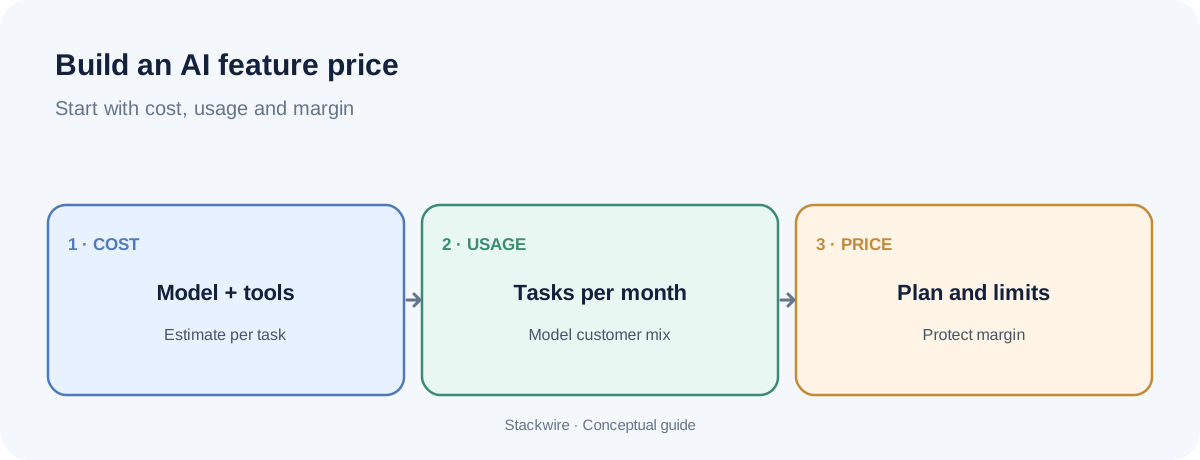
A practical way to price an AI feature is a hybrid plan: charge a base subscription, include a defined amount of AI usage, then charge for usage above that allowance. Measure your real cost per task first, and make usage visible so customers are not surprised.
Why seats alone fall short
Traditional SaaS margins were stable because infrastructure cost barely changed per user. With AI, cost follows usage. Two customers on the same seat price can cost you very different amounts, and the heaviest user is often the one who loves the feature most.
A practical starting point: compare hybrid pricing
A hybrid plan is one option worth testing: a base subscription with a defined AI allowance, followed by metered usage or credits when customers go beyond it. It can balance predictable revenue with usage-linked costs, but it is not right for every product. Pure usage pricing may fit developer tools or workloads with clearly measurable consumption. Seat-based pricing can still work when usage is light, consistent or bundled into a broader product benefit. Choose after comparing customer expectations, actual cost distribution and willingness to pay.
A worked example (illustrative numbers)
Say one AI task costs you $0.04 in model fees. A customer running 500 tasks a month costs you $20, and one running 5,000 costs you $200. If both pay the same $30 seat, the second is a loss. Include 500 tasks in the plan and charge, say, $0.08 for each extra task, and the heavy user pays for what they use.
Five steps
- Measure your real cost per task, including retries and long inputs.
- Decide what is included in each tier so AI feels part of the product.
- Set an allowance that covers most customers and meter the rest.
- Show usage inside the app so overages never surprise anyone.
- Review prices every quarter, because model costs and customer habits change fast.
Which AI SaaS pricing model should you choose?
There is no single best AI pricing model. Choose the unit that customers can understand and that tracks your cost driver closely enough to protect the business. A product that summarizes one short email has a different cost profile from an agent that searches documents, calls tools and runs several model steps.
| Model | Works well when | Main risk |
|---|---|---|
| Per seat | Usage is light and similar across users, or AI is a supporting feature. | A few power users can consume far more resources than the average seat. |
| Usage-based | Customers can connect usage directly to value, such as API calls or documents processed. | Unpredictable bills can make buyers hesitant. |
| Credits | Different actions have different costs and customers need a visible allowance. | Opaque credit conversion can frustrate customers if the unit is hard to understand. |
| Hybrid | You want a predictable subscription plus a usage allowance and paid overages. | Allowance size and overage rules need careful design. |
| Outcome-based | The result can be measured and attributed reliably, such as a verified workflow completed. | Disputes arise when success criteria or attribution are unclear. |
For many early products, a hybrid structure is a sensible starting hypothesis, not a universal industry rule. It gives customers a known base price while letting the business meter unusually heavy usage. Validate it with customer interviews and actual cost data.
Calculate gross margin before setting the allowance
Start with the full variable cost of one successful task. Include model calls, retrieval or search, third-party tools, storage or compute that scales with usage, retries and human review where it is part of normal delivery. Our guide to calculating AI API costs explains how to measure the model portion.
For a simple illustration, assume a plan costs $30 per month, includes 500 completed AI tasks, and each task costs $0.04 in variable AI charges. The included usage costs $20, leaving $10 before payment fees, support, hosting, sales and other operating costs. This is not a 33% company gross margin calculation because it excludes those other costs.
If the customer completes 5,000 tasks, the extra 4,500 tasks cost $180 at the same assumed unit cost. If overage is $0.08 per task, the customer pays another $360 and the total plan revenue is $390. Against $200 of assumed AI cost, $190 remains before all other costs. This shows why the included allowance and overage price must be tested together.
Test the economics of an AI feature plan
Change these assumptions to estimate monthly revenue and variable task cost for one customer. The estimate excludes payment fees, support, fixed hosting and other operating expenses.
Estimated revenue: $30.00
Variable task cost: $20.00
Contribution before other costs: $10.00
This is a planning estimate, not a recommended market price. Use measured cost per successful task and test customer willingness to pay.
How to choose an allowance
- Measure a real usage distribution. Use several weeks of representative product data if you have it. Look at median usage and heavy-use percentiles, not only the average.
- Segment customers by job. A support team, a solo founder and an agency may use the same feature very differently.
- Set an allowance around a customer outcome. “500 document summaries” is easier to understand than an unexplained bucket of 40,000 tokens.
- Model the high-usage case. Check whether a customer who uses the full allowance plus overages remains commercially viable.
- Revisit the unit when the product changes. A new agent workflow or longer context window can change cost per task.
Make AI usage understandable inside the product
Show customers what counts as a task, how much of their allowance remains, when it resets and what happens after they reach the limit. Send a warning before an overage begins. Offer a way to set a spend cap or pause optional AI work where practical. If you use credits, publish a simple conversion table and explain whether failed tasks consume credits.
Do not quietly change the value of a credit or the definition of a completed task. Pricing is part of the product experience. Confusing billing can erase the trust created by a useful AI feature.
Test the price with customer evidence
Ask potential buyers how they budget for the problem today, what outcome would justify paying more, and whether they prefer a predictable monthly allowance or a bill tied to usage. Test a few clear packages rather than asking “what would you pay?” in the abstract. Compare conversion, activation, usage, expansion, churn and support tickets after launch.
Track contribution margin by customer cohort. If the most engaged customers are also the least profitable, you may have a pricing or product-efficiency problem. If customers rarely reach the allowance, the package may be too generous or the feature may not be valuable enough to drive usage.
Common AI pricing mistakes
- Pricing from model token rates alone: model fees are only one part of delivering a reliable feature.
- Calling usage unlimited: this creates open-ended exposure when a workflow can loop or be automated.
- Charging for tokens customers cannot interpret: expose a meaningful product unit where possible.
- Ignoring quality: the cheapest model may create more retries, corrections or support costs.
- Changing limits without warning: explain plan changes and give customers time to adapt.
Frequently asked questions
Should AI features be priced per user or per usage?
Use per-seat pricing when usage is relatively predictable and the feature is included in the value of the seat. Use usage pricing when cost or customer value rises directly with activity. A hybrid model can combine a base subscription with an included allowance and transparent overages.
How much should I charge for an AI feature?
There is no reliable universal price. Calculate cost per successful task, understand how much customers value the outcome, then test a price that covers variable costs and contributes to the rest of the business. Validate with real usage and willingness-to-pay evidence.
Are AI credits better than tokens?
Credits can make billing easier when different AI actions have different costs. Tokens are more transparent to technical buyers but can be difficult for non-technical customers to predict. If you use credits, explain exactly how each action consumes them.
Can I offer unlimited AI usage?
Only if you have evidence that the cost distribution is predictable and the plan remains profitable under heavy use. Otherwise, set a fair-use policy, allowance, usage cap or overage structure that customers can understand.
All figures in the examples are illustrative, not market benchmarks. Use your own cost data and test assumptions with customers.
Have expertise to share? Write for Stackwire and publish your own article.